Expert news, buying guides, and technical insights from HAYA Autos Co., Ltd.
Explore Used TrucksCoach, city, school, and mini buses updates for international buyers.
Explore Used BusesTractor heads and dump trucks operational standards & reviews.
View Tractor TrucksOEM-quality parts and secure shipping solutions worldwide.
Browse Spare PartsTrusted B2B commercial vehicle exporter from China.
About HAYA AutosA Mining Dump Truck is a heavy-duty vehicle built to move large volumes of rock, ore, and waste across mine sites. Its job sounds simple: carry material from a loading area to a crusher, stockpile, or dump point. The real work is more demanding. Steep ramps, loose surfaces, dust, and repeated loading cycles test the truck’s frame, tires, brakes, and powertrain every shift.
Mining haulage researcher Ali Soofastaei has studied equipment efficiency and haulage operations. A concise paraphrase of a principle reflected in his published work is: “Match the truck’s payload, route, and operating cycle to improve haulage efficiency.” This is an editorial paraphrase, not a verified verbatim quotation. It highlights a practical point: selecting a truck by capacity alone can overlook road conditions, loading equipment, fuel use, and maintenance needs.
The scale is immense. Some models carry hundreds of tonnes, while smaller units serve tighter or underground routes. Large rigid-frame trucks commonly work in open pits; articulated models can handle uneven terrain and sharper turns. Their visible features include a high-sided body, oversized tires, access ladders, and a cab designed for long operating hours. Details matter. A poorly maintained haul road can increase tire wear and slow each trip. This guide explains what a Mining Dump Truck is, how its main systems work, where different types are used, and which operating factors affect productivity and service life. It also considers limitations, because no truck performs equally well on every route.
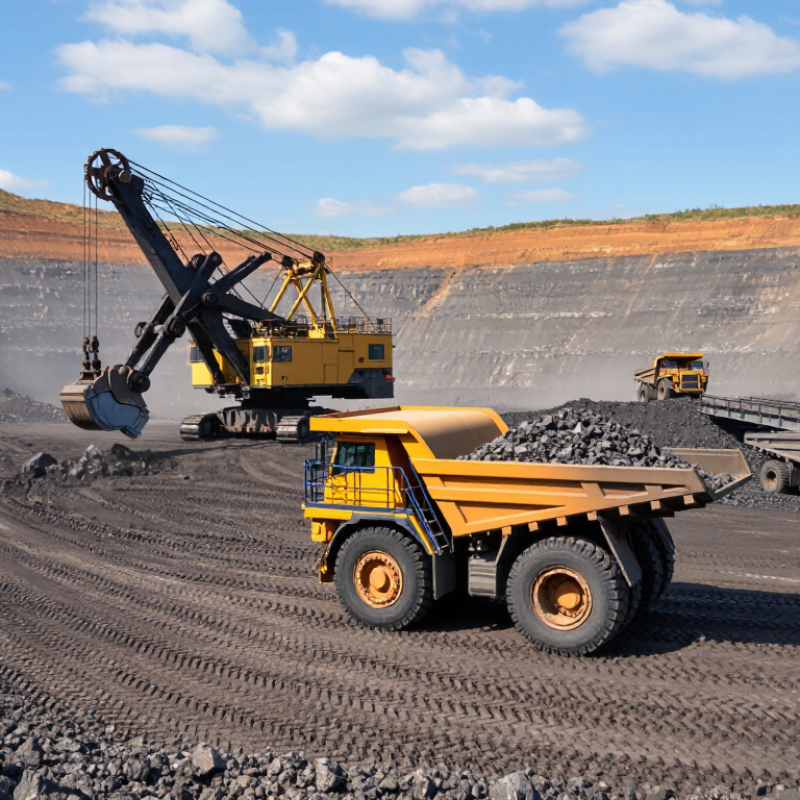
What Is a Mining Dump Truck?
Definition and Purpose of a Mining Dump Truck
A mining dump truck is a heavy-duty vehicle built to carry excavated rock, ore, and overburden around a mine. Its large, reinforced body, called a dump body, tilts to release a load at a designated location. The truck may travel between a loading area, haul road, and crusher or waste pile. It is not simply a larger road truck. Its frame, tires, braking systems, and powertrain are designed for heavy loads and demanding, uneven routes.
Its main purpose is to move material efficiently within the mine. A loader may fill the body in several passes, while the truck’s operator follows site routes and loading instructions. Then the truck climbs or descends haul roads, often in dry dust, loose gravel, or changing weather. Visibility, stopping distance, and road condition matter. Very much. A poorly maintained road can affect travel time and tire wear, even when the truck itself is operating well.
Mining trucks vary in size and design to suit the terrain, material, and distance traveled. Some use a rigid frame for large open-pit routes; others have articulated joints for more uneven ground. The right choice depends on the whole operation, not just carrying capacity. In practice, loading speed may look impressive, but waiting, turning, and dumping also shape productivity. That detail is easy to underestimate. A truck’s purpose is reliable movement, and the best measure is often how safely and consistently it completes the haul cycle.
Mining dump trucks haul blasted rock, ore, and overburden between loading areas and processing or dumping sites. Payload varies by truck size; the figures shown are approximate representative capacities in metric tonnes.
A mining dump truck combines a reinforced frame, a large haul body, and a high-capacity powertrain. The frame carries heavy loads across uneven haul roads, where vibration and impact are routine. It is massive. Cross-members help distribute stress, though wear can still develop around joints and mounting points. The body is commonly made from abrasion-resistant steel, with sloped sides that guide broken rock toward the rear during unloading. Floor thickness and body shape vary with the material being hauled. Hard, sharp ore can wear surfaces faster than softer material, so inspections matter.
Large tires provide ground clearance and help absorb jolts, but they need careful pressure and temperature monitoring. The engine and transmission are matched to steep grades and repeated stop-start cycles. Cooling systems work hard in dusty, hot conditions. A hydraulic hoist raises the body, often using large cylinders that must extend smoothly under load. The cab places controls, displays, and visibility aids where operators can monitor the route and machine. Good sightlines are valuable, yet blind spots remain around such a large vehicle. Braking systems are designed for heavy loads and long descents, with additional retardation helping reduce service-brake wear. These systems need regular checks; a small leak or worn connection can become a costly problem.
A mining dump truck begins its work with a walk-around inspection. The operator checks tires, lights, mirrors, fluid leaks, and the body for visible damage. Inside the cab, gauges and warning systems are checked before the truck moves. Small details matter. A radio or onboard system keeps the operator in contact with the loading crew and other vehicles.
At the loading area, the truck is positioned where the excavator or loader can place material evenly in its body. The operator then follows the haul route, adjusting speed for the load, road surface, visibility, and slope.
The routine can feel repetitive, and that is exactly when attention may soften. On the return trip, braking distance and road conditions still deserve close attention, even when the truck is empty.
At the dump point, the operator confirms the ground is firm and the area is clear, then raises the body to release the load. The truck must remain stable while material slides out. If it sticks or shifts unevenly, the operator should stop and follow site procedures rather than force the body. After lowering it, the truck is ready for another cycle.
Mining dump trucks are designed around the ground they must cross and the material they carry. Rigid-frame trucks have a fixed chassis and large payload capacity. They are common in open-pit mines, where wide haul roads support their size. Articulated dump trucks bend at a joint between the cab and body. This helps them turn across muddy, uneven routes, though they usually carry less than the largest rigid trucks. Underground mining trucks are lower and narrower, allowing them to travel through confined tunnels. Some large surface trucks use electric-drive systems, which can suit steep haul routes. Each type has trade-offs.
Tips: Match the truck to road width, slope, payload, and turning space. Check tire condition and braking systems during routine inspections. A truck that fits the load may still be wrong for the route.
Specifications tell only part of the story. A rigid truck may move more material per trip, but poor road conditions can slow it down. An articulated model may handle rough ground better, yet repeated overloading can strain its frame and tires. Underground machines need enough clearance for their route, not just a high payload rating. Conditions change, too. Dust, rain, and loose rock can make a familiar haul road behave differently, so operators and maintenance teams should review performance on site.
A mining dump truck is a heavy vehicle built to move large loads across mine sites. It commonly carries ore, waste rock, or overburden from loading areas to crushers, stockpiles, or disposal areas. Its large body tips to unload material, but the truck’s size also demands carefully planned routes. A narrow bend can become a serious bottleneck.
Daily operation depends on more than carrying capacity. Haul roads need stable surfaces, clear edges, and grades suited to the equipment. Operators must account for wet conditions, loose material, and changing visibility. Visibility is limited. Pre-shift checks should include tires, brakes, lights, and steering. Loads also need even distribution; an uneven pile can affect stability during travel or dumping. Site procedures and operator training help reduce risks, though rushed checks can still happen.
Tips: Keep travel routes clear and mark changes in road conditions. Use a spotter where blind areas or tight dumping zones make communication important. Allow enough stopping distance, especially on slopes or slippery ground. Review near misses, too. Small details, like a soft shoulder, can be easy to overlook until conditions change.
It carries excavated rock, ore, or overburden between mine areas. Its tilting body unloads material at a crusher, stockpile, or waste pile.
Its frame, tires, brakes, and powertrain are built for heavy loads and rough mine routes. It is not simply a larger road truck.
Rigid-frame trucks suit wide open-pit roads and carry large loads. Articulated trucks turn more easily on uneven ground. Underground trucks are lower and narrower.
Consider road width, slopes, turning space, terrain, and payload. A truck may fit the load but still be wrong for the route.
They move ore, waste rock, and overburden. A loader may fill the body in several passes.
Check the tires, brakes, lights, and steering. Also review the route and any changes in weather or road conditions. Small details matter.
Dust, rain, loose gravel, and soft shoulders can change traction and stopping distance. Poor roads may increase travel time and tire wear.
An uneven load can affect stability while driving or dumping. The pile may look harmless, but that assumption deserves a second look.
Keep routes clear and use a spotter when visibility or turning space is limited. Allow extra stopping distance on slopes or slippery ground. Visibility is limited.
A Mining Dump Truck is a heavy-duty vehicle designed to move large quantities of rock, soil, and other materials around a mine. Its reinforced frame, high-capacity dump body, powerful engine, specialized tires or tracks, and hydraulic lifting system help it handle demanding loads and rough terrain. Depending on the mine layout and hauling needs, operations may use rigid-frame trucks, articulated trucks, or other purpose-built designs.
During a typical cycle, the truck is loaded at an excavation area, travels along a planned haul route, and raises its body to unload at a designated location before returning for another load. Safe and efficient operation depends on matching the truck to the terrain and material, managing payloads, maintaining clear routes, and inspecting key systems regularly. Good planning and operator training also help reduce unnecessary wear, support reliable hauling, and keep mining activities running smoothly.